For startups

Your in-house legal team, from day one.

Law firms only take a startup once VCs fund it. Before that, the founders are on their own, and a template stops at the download. FinePrint is the in-house legal team from $100 a month. It knows your company, runs the legal work, and brings in a licensed lawyer when a question needs one. The Legal Room starts on day one.

101

legal endpoints, each a whole transaction, not a template

8

specialist agents, all reading one Legal Room

$100

a month for the whole company, not per seat

$0

on top when a lawyer reviews. Lawyer review is included

What it runs for you.

Three kinds of work carry a company from the charter to the round: the raise, the paper other people send you, and the paper the company has to make itself. All three run on one record and write back to it when they are done.

Raise

Fundraising documents that keep the record true.

/issue-safe issues on your standard terms and checks side letters against what you have already promised other investors. /prepare-data-room builds the diligence room from a record that is always current. /close-priced-round and /file-form-d when the round is real. After signature, the cap table and the record are updated, so the next raise starts from the truth.

What a diligence room has to hold

Review

Every contract back the same day.

/review-contract reads the other side’s paper against your positions and against what you have already promised, and returns an issue list and a redline. Your own paper (/create-nda, /create-msa, /create-sow, /create-dpa) goes out on your standard terms, gets signed, and files itself in the Legal Room.

The eight specialists, and what each one owns

Run

Create and finish the company’s paperwork.

/incorporate, /hire-employee, /grant-options: the offer, the PIIA, the policies, the board consent, the state filing, the 83(b) with its 30-day clock closed out. Anyone can draft an offer letter. The endpoints run everything around it.

Watch one hire run, frame by frame

Between your questions, it watches. The record’s Today view names what is missing, what does not match, and what is due soon.

A matter, running

A SAFE, and the one line in it that needed a lawyer.

An angel wants to put in $250,000 ahead of the round and sends back a side letter with their own terms. The SAFE is standard work. The side letter is not. The answer depends on what the company has already promised two earlier investors.

FinePrint reads the record first, drafts on your terms, and stops at the one clause it has not been taught. Nothing starts until you approve it.

Matter M-0912 · Northwind Robotics Running

RUN /issue-safe

  investor: angel · amount: $250,000 · terms: your standard post-money SAFE

read record — cap table, three prior SAFEs, board authorityTue 9:12

instrument drafted on your standard terms, cap and discount setTue 9:14

side letter — the investor’s most-favored-nation clause meets a term promised in March Yellow attorney & scope on screen · includedTue 10:40

/create-board-consent — routed to 3 directors, countersignedWed 8:20

write back — cap table, Legal Room, diligence indexWed 11:05

Signed Wednesday, on your paper. The SAFE, the side letter and the board consent are in the Legal Room. The cap table carries the new instrument. The next investor who asks what you have already promised gets the answer from the record.

Northwind Robotics is an example company.

Pick the page that matches your stage.

Legal work changes shape at each stage. Each stage page names what breaks, what FinePrint runs, and a worked matter start to finish.

Stage 01

Solo founder & pre-seed

Get incorporated properly, and stay that way.

The mistakes here are cheap to prevent and expensive to unwind: the 83(b) window, founder stock never issued, a contractor who never assigned IP. The record starts here.

Solo founder — $100/mo

Solo founder & pre-seed

Stage 02

Series A

Diligence tests your record, not your lawyers.

A request list arrives and the company finds out which of its documents disagree with each other. The work is not writing new documents. It is proving the old ones are true.

Growth — $1,000/mo

Series A

Stage 03

Growth

Volume is the problem now.

A DPA on every deal, a new state each time recruiting wins, a board that expects minutes. Nothing is new. There is more of it than one person can hold.

Growth — $1,000/mo · Enterprise above it

Growth

Past all three? At 50 people and again at 500 the shape changes again: a legal function that already exists, procurement on the other side of the table, a security review before anyone signs. FinePrint for mid-market · FinePrint for enterprise

The endpoints a startup uses.

101 endpoints across eight specialist agents. These four lanes carry a company from the charter to the round. The rest sit on the same Legal Room and open the day you need them.

Formation12

The company made real: charter filed, stock issued, the 30-day clock closed out.

/incorporate /issue-founder-stock /file-83b
Hiring13

Offers with the right notices for the right state, and everything that follows one.

/hire-employee /engage-contractor /convert-contractor
Equity8

Grants papered against the plan, the pool and a current 409A. Never against a promise in Slack.

/grant-options /adopt-equity-plan /order-409a
Fundraising6

Instruments issued on your terms, the round closed, the room built before an investor asks for it.

/issue-safe /close-priced-round /prepare-data-room

An endpoint runs the whole transaction, not a template. /hire-employee is seven documents, a board consent, a state registration and a calendar that starts counting. One call. Finished.

Where a lawyer comes in.

Every matter carries a level. The level decides who touches it.

Green — agents run it.

Standard work runs end to end, with your approval. Lawyers score samples of the output.

Yellow — a lawyer confirms.

The matter is outside what the model has learned, so it stops. A licensed attorney answers before anything moves. Included in your plan.

Red — a lawyer leads.

A financing, a dispute, a regulated question. A specialist takes the matter with the file already built.

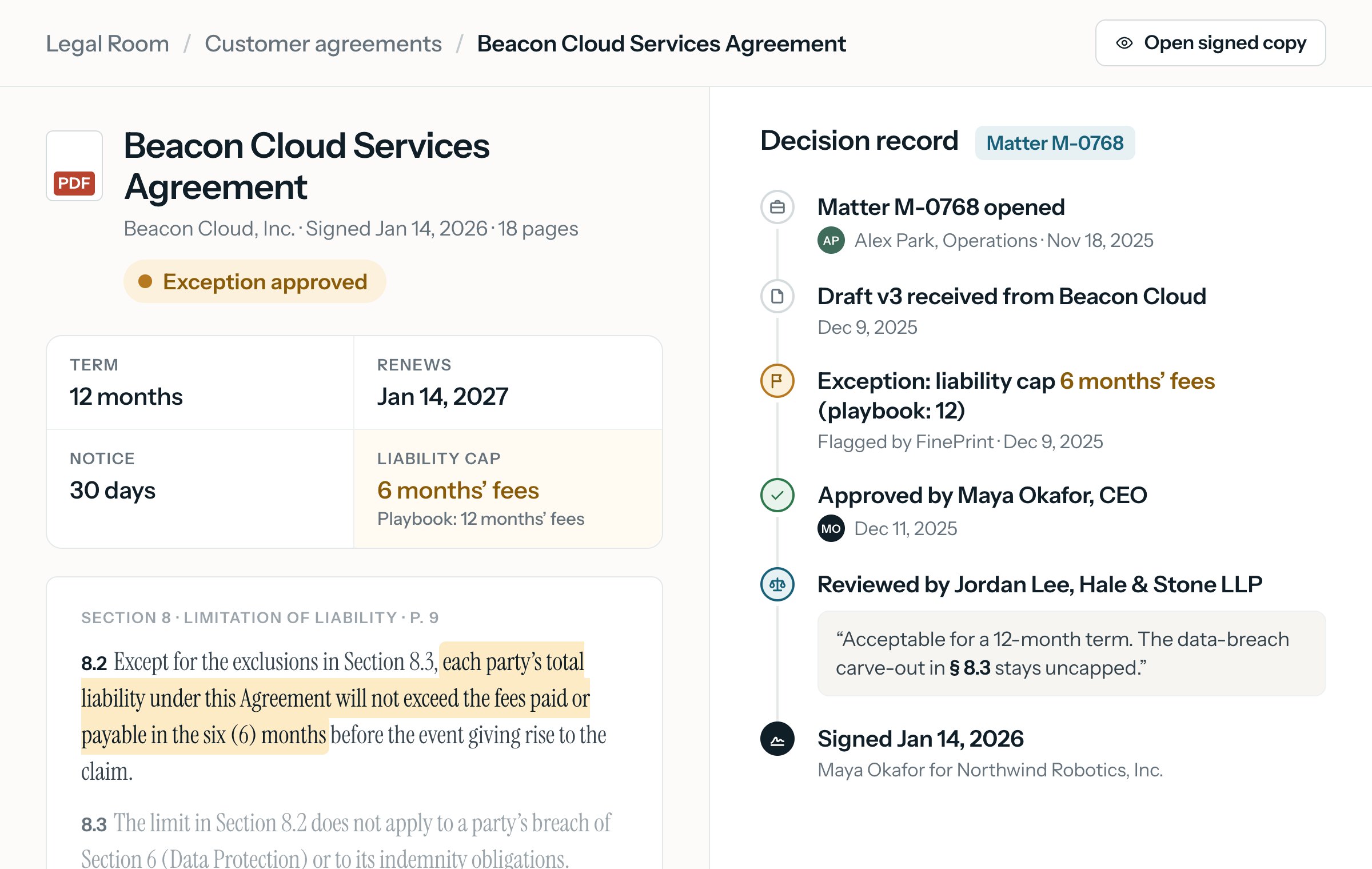
At a startup, Yellow is one of four things: a founder still employed somewhere else, an investor’s own paper coming back with terms on it, a hire in a state the company has never employed in, or a customer asking you to stand behind something you do not control. Each one gets a licensed lawyer, at no cost on top of the plan.

Lawyers score samples of Green work. A lawyer reads your matter when it goes Yellow or Red. Nothing starts until you approve it. Who reviews the work

Priced like software, not like counsel.

One published price a month, for the company, not per seat. The founder, the recruiter and the person who sends the contract all use it. Nobody pays per login.

  • Solo founder — $100. Pre-formation, or just incorporated: the record, the Legal Room, and the formation endpoints.
  • Startup — $300. First hires, first contracts: two specialist agents of your choice and every standard endpoint.
  • Growth — $1,000. A real team and a board: all eight specialist agents and priority lawyer review.

Enterprise sits above these: your own Legal AI model, several entities, your own policies, your keys. Government fees (Delaware, the states, the USPTO) are passed through at cost. Lawyer review is included.

Around 90% less than a typical retainer. Where the number comes from

Questions founders ask first.

Do I still need a law firm?

For a financing, a dispute, an acquisition or a regulated question, yes. FinePrint routes those Red, with the file already built: the record, the documents, the history and the issue list. You spend less on a specialist without getting less from one. The routine work stops being billed by the hour.

What happens on day one?

You pick the plan for your stage and we set up your Legal Room with you. Signed documents you already hold are filed into the Legal Room and the record is built around them. The first endpoint runs the same day.

Is this legal advice?

FinePrint is a legal technology company, not a law firm, and does not provide legal advice. The software runs the work. Where judgment is required, a licensed attorney reviews the matter or takes it, engaged by you, with the scope shown first. The review is included in your plan.

What does it cost when a lawyer gets involved?

Nothing on top of the plan. When a matter goes Yellow you see the attorney and the scope on screen. What you approve is the scope. There is no fee attached and no invoice afterwards.

Can the whole team use it, or just me?

The whole team. The plan is for the company, not per seat, so the recruiter sending offers and the account executive sending order forms are both inside it. Per-seat pricing makes companies ration their own legal team. Nobody pays per login.

We already have signed contracts and a folder of documents. Can you take them?

Yes. That is the normal way to start. Signed documents you already hold are filed into the Legal Room and the record is built around them, marked as arriving from outside, carrying what we can verify about them.

Today then shows you which rows are still missing, which two documents disagree, and what is due soon. For most founders it is the first time the whole record has been in one place.

Which jurisdictions does this cover?

The United States: Delaware and the states, the federal filings, and the state registrations that follow a hire into a new place. If your company is incorporated elsewhere, or you are about to employ someone outside the US, say so early. FinePrint routes those questions to a licensed attorney.

What is my record used for?

Running your company’s legal work, and nothing else. It is encrypted and company-isolated, with per-document keys. It is never training data for a shared model. That is the Two-Corpus Rule: FinePrint LM learns from lawyers’ reviews, never from your record. You can export everything or delete it permanently, on any plan, on any day.

Start before the next contract arrives.

All of this is cheap to do now and expensive to reconstruct later.

Thirty minutes, live. We run one endpoint start to finish for a company at your stage, and tell you which plan fits.

Book a demo

Or watch it first. The walkthrough runs one hire end to end: the seven documents, the board consent, the state filings, the question that stopped for a lawyer, and the record updating after.

Watch the demo